
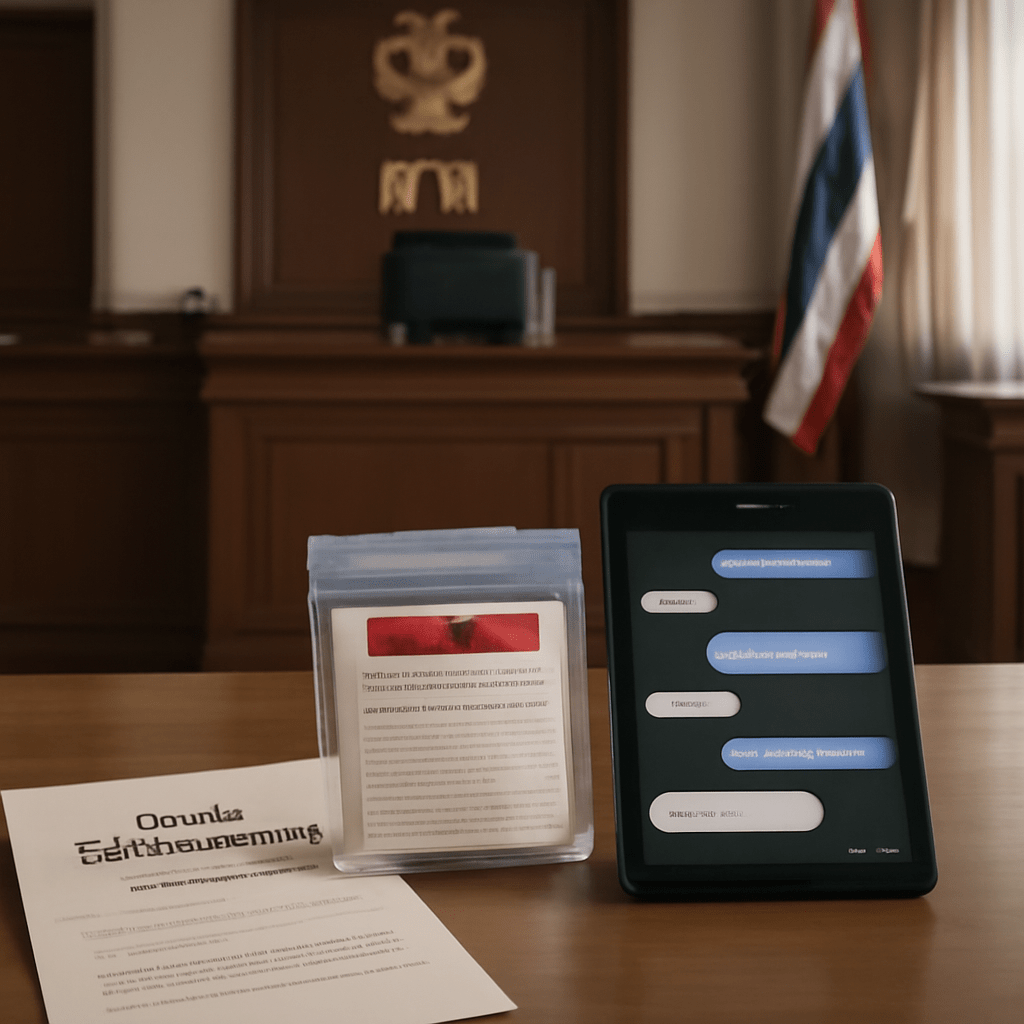
When the police knock, or a summons lands in your hands, the case stops being abstract. It becomes about evidence—what the state can present against you, how it was gathered, whether it holds up under scrutiny, and what you can do about it. Thai evidence law is not a copy of any foreign system; it has its own texture and standards. The court in Udon Thani will look at relevance, reliability, and lawfulness—while also expecting the defense to raise precise, timely objections. You do not need to accept every photo, chat log, or confession as unshakable. You do need a plan. This guide explains the types of evidence commonly used in Thailand criminal cases, what makes evidence strong or fragile, and practical steps to challenge it—calmly, methodically, and with your rights front and center.
Quick Answer

The short version: what usually counts as evidence
Thai courts accept many forms of proof—testimony, objects, documents, digital data, and expert opinions—provided the evidence is relevant and credible. The defense can attack gaps in collection, storage, translation, or interpretation.
In a Thailand criminal case, the state can build its file from almost anything probative: eyewitness accounts, surveillance footage, seized items, chat logs, bank transfers, medical certificates, forensic results, and statements from the accused. Relevance is the threshold. Reliability decides the weight. Procedure—how authorities collected and preserved the item—often determines whether the court will trust it.
Expect the prosecution to organize evidence around a narrative: time, place, identity, intent, and causation. Your job is to test each element. Was the witness in a position to see? Did the lab follow protocol? Is the screenshot authentic? Thai evidence law allows the court to accept or reject parts of the story; it is not all-or-nothing.
If your case is in Udon Thani, the process is still governed by national law and Court of Justice practice. Local details—like hearing dates or interpreter availability—depend on scheduling and resources, not a separate rulebook.
Common types of evidence used against you in Thailand criminal cases
Prosecutors rely on people, papers, devices, and science. Each category has known pressure points that the defense can probe.
- Witness testimony: Victims, bystanders, and police talk. Courts weigh demeanor, consistency, and plausibility. Memory distorts; cross-examination matters.
- Confessions and statements: A signed statement can be powerful, but only if voluntary and reliable. If language barriers, coercion, or misunderstanding tainted the process, challenge it.
- Physical evidence: Weapons, clothing, packaging, tools. The chain of custody—who handled what, when—must be clear. Gaps can erode trust.
- CCTV and images: Timestamp integrity, device origin, and uninterrupted storage are key. A clean video may still have context issues.
- Digital and phone records: Chats, call logs, emails, and location data are common. Authentication (device ownership, metadata, extraction method) becomes the battleground.
- Financial and business records: Bank statements, invoices, ledgers. Look for translation errors, incomplete sets, and missing attachments.
- Forensic and medical reports: DNA profiles, toxicology, autopsy notes, injury assessments. These rely on lab standards and sampling protocols. Expert cross-examination can be decisive.
- Expert opinions: Specialists interpret data—ballistics, handwriting, digital forensics. Experts can disagree; methodology is fair game.
None of these items is automatically conclusive. Thai courts can accept, discount, or reject an item, depending on the totality of circumstances.
Thai evidence law in practice: relevance, reliability, and procedure
Courts admit relevant evidence if it appears reliable and was obtained in line with Thai procedural safeguards. Breaches can reduce weight or lead to exclusion, depending on the facts.
Thai judges act as gatekeepers of proof. They look at whether a piece of evidence logically connects to a fact in issue (relevance), whether it seems trustworthy (reliability), and whether the authorities followed required procedures (lawfulness). There is no single checklist that fits all cases; outcomes depend on context and judicial discretion.
- Chain of custody: The prosecution should show a documented path for physical and digital items. Unexplained breaks can undermine authenticity.
- Interpretation and translation: If you do not speak Thai fluently, an interpreter should assist during questioning and in court. Mistranslations can be challenged with certified translations and expert testimony.
- Document authenticity: Originals, certified copies, or verifiable digital records carry more weight than casual printouts. Screenshots alone are rarely enough without corroboration.
- Expert methodology: Courts expect accepted techniques, calibrated tools, and clear reporting. If a lab report is silent on method or sampling, highlight the gaps.
The Royal Thai Police publish guidance on rights of the accused; those rights are not abstract. If key rights were disregarded during arrest or questioning, the defense can argue to exclude the product or reduce its probative value. Always preserve the record—dates, times, names, and what was said—so the court has a basis to evaluate your objection.
For arrest-stage planning in Udon Thani, see our step guide: What to Do Immediately After an Arrest in Udon Thani.
Illegally obtained evidence in Thailand: what it may mean for your case
Thailand does not apply a single automatic exclusion rule for every unlawful search or irregular interview. Courts weigh the circumstances and may exclude or discount evidence if rights or procedures were seriously compromised.
People often ask whether “illegally obtained evidence” is automatically thrown out. Thai law does not mirror a strict exclusion model from other jurisdictions. Instead, judges assess how the evidence was obtained, whether procedural rights were respected, and whether reliability has been affected. Serious violations—coerced statements, clear breaches of core safeguards, or tampering risks—can justify exclusion. Lesser irregularities may reduce weight rather than lead to outright rejection.
- Statements and confessions: If you were not properly informed, lacked interpretation, or felt coerced, the court can treat the statement with caution. Demonstrable coercion is especially serious.
- Search and seizure issues: If items were seized without necessary authority or beyond the scope of a lawful search, the defense can challenge admissibility or weight. The remedy depends on the facts and the court’s view of fairness and reliability.
- Digital extractions: Phone and computer imaging should follow credible protocols. Unexplained alterations, missing logs, or private data mining beyond the case scope are red flags.
Outcome depends on evidence quality, procedural history, and timely objections. Do not rely on broad theories. Bring specific, document-backed arguments.
How to challenge evidence in Thai court: a step-by-step defense playbook
Move fast, get the file, map the proof, and attack the weakest links with precision—through motions, cross-examination, and your own expert analysis.
- Secure counsel early: A focused defense starts before evidence hardens into a trial narrative. Consult a local team experienced in Criminal Lawyer Udon Thani.
- Obtain and index the case file: Request access through lawful channels. Create an index: who collected each item, when, where, and how it connects to a specific charge.
- Build an evidence map: For every exhibit—witness, device, document—note the chain of custody, translation needs, and authenticity proofs. Gaps become targets.
- File focused motions or objections: Raise admissibility issues in writing where appropriate, and renew them during trial. Be specific: which item, what defect, and what remedy you seek (exclusion or reduced weight).
- Cross-examine to expose method flaws: With forensic or digital items, ask about validation, calibration, and error rates. For witnesses, test line of sight, lighting, distance, and prior statements.
- Use your own experts: Independent forensic, medical, or digital experts can re-check lab work, authenticate devices, and translate technical jargon into credible testimony.
- Address language and translation: If interviews or chats were translated, request the original media and provide certified translations. Differences in nuance can be critical.
- Preserve appellate issues: If the court admits disputed evidence, ensure your objection and reasoning appear on the record to protect your rights on review.
Criminal defense is not guesswork. It is a systematic audit of the state’s proof—calm, relentless, and documented.
Udon Thani court evidence rules: practical expectations without the myths
Your case proceeds under national law. Practicalities—scheduling, interpreters, and exhibit handling—depend on the court’s calendar and resources, not unwritten shortcuts.
Cases in Udon Thani follow Thai criminal procedure and evidence principles applied nationwide. Hearings are scheduled by the court; filings must be precise and on time; interpreters can be arranged where necessary. There is no fixed timeline that fits every case. Duration depends on charge type, witness availability, translation needs, and whether forensic testing is pending.
- Exhibit handling: Labeling and custody records matter. If an exhibit changes hands, the file should show it.
- Digital displays in court: If the prosecution plans to play CCTV or present chat logs, ensure you receive the original media files and metadata—not just screenshots.
- Interpreter and translation logistics: Provide advance notice for non-Thai materials. Certified translations may be required, and timing depends on document volume and language pairs.
- Family support: Families can help by organizing documents, funding expert reviews, and tracking dates, but they should avoid contacting witnesses or handling exhibits.
If detention is at issue, official Court of Justice resources explain bail applications and criteria, and there is guidance on when a court may allow release without security. Decisions remain discretionary, fact-specific, and time-sensitive.
For property crimes specifically, our explainer on charges and defenses may help you understand overlapping issues: Theft and Burglary Charges in Thailand.
Costs, timing, and what families can do right now
Budget for the essentials—lawyer time, translations, expert review, and court appearances. Act quickly; organize everything; document every interaction.
Legal spend should follow your defense priorities: obtain the file; analyze high-risk evidence; engage translators and independent experts where needed; prepare motions and cross-examination. Costs vary with complexity, the number of exhibits, and whether extended hearings are required. Timelines depend on the court’s schedule, witness availability, and any outstanding lab work or document translations.
- Immediate checklist for families:
- Create a secure folder (digital and physical) for all papers, dates, and contact info.
- List potential witnesses and what each can speak to. Avoid coaching; just capture facts.
- Preserve your own evidence—messages, photos, receipts—in original form.
- Note language needs early. Arrange certified translations where appropriate.
- Keep a timeline of arrest, questioning, and any searches. Record names and times.
- Coordinate with counsel before speaking to police or the media.
- Detention and release: Bail or release decisions are not guaranteed. Official Court of Justice materials outline application steps and situations where security might not be required. Results depend on the court’s assessment of flight risk, severity, and other factors.
Quick legal note for families (divorce by mutual consent in Thailand): If, during a criminal case, your family also faces a civil family-law decision, remember: a divorce by mutual consent must be in writing, signed and witnessed as required by Thai law, and it becomes legally effective only when properly registered, where that registration step applies. A sound agreement should address property, debts, children, custody, visitation, and support. Foreign-language or foreign-issued documents may need translation or legalization, depending on the district office and intended use. If spouses cannot agree, court proceedings—rather than administrative registration—may be required. Requirements can vary by district office and individual facts. For a focused overview, see: Divorce by Mutual Consent in Udon Thani.
If you are weighing next steps, a short consultation can triage risk and sequence your defense work. Move first on items that are time-sensitive—detention, device access, and preservation of digital data.
Did You Know? (Legal & Data Insight)
Did you know? Nationally, there was only 1 case filed involving enforcement of court judgments, highlighting the relative priority of legal issues across the country.
Source: Ministry of Justice Thailand, Open Data (MOJ)
Need Legal Assistance?
If your documents require translation, certification, or you are unsure which district office to choose in Bangkok, contact our legal team immediately. We will review your case, confirm local requirements, and help you register your marriage without delay.