
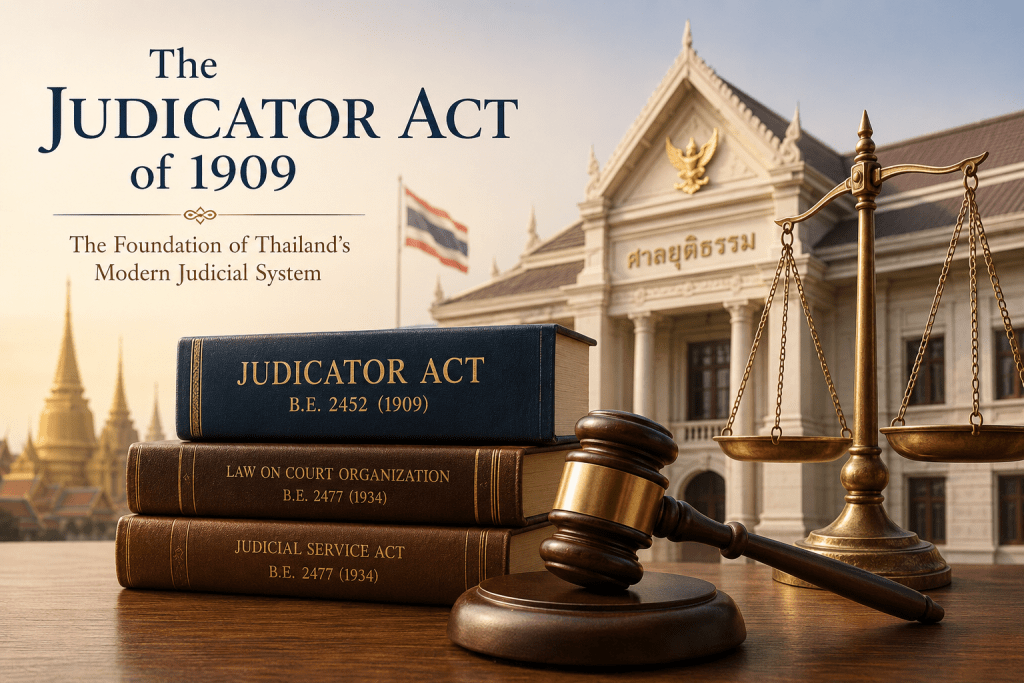
The Judicator Act enacted in 1909, historically known as the Judicator Act B.E. 2452, represented a fundamental structural break from Thailand's traditional monarchical system of justice. Prior to its enactment, ultimate judicial authority rested personally with the King, to whom dissatisfied subjects could directly appeal during royal audiences and travels (Court of Justice Thailand, n.d.; NUS Law, n.d.).
With the enactment of the 1909 law, the Supreme Court, or San Dika, was formally established as the highest and final appellate court of the Kingdom. Legal disputes could no longer be submitted directly to the King for adjudication. This institutional separation significantly professionalized the Siamese judicial system and created predictable judicial procedures (Court of Justice Thailand, n.d.; Globalex, n.d.).
The Siamese Revolution of 1932
The Siamese Revolution of 24 June 1932 ended centuries of absolute rule by the Chakri Dynasty and transformed the state into a constitutional monarchy. The first constitution declared that judicial power would henceforth be exercised by the courts. Judges continued to render judgments “in the name of the King,” while being guaranteed independence in the interpretation and application of the law (Globalex, n.d.; NUS Law, n.d.).
However, the practical implementation of judicial independence remained difficult. Although judicial decision-making independence was constitutionally guaranteed, the personnel and financial administration of the judiciary remained under the Ministry of Justice, creating a risk of political influence over the courts (Globalex, n.d.).
The Judicator Act of 1934
To address this weakness and implement the separation of powers, the National Assembly enacted the Law on Court Organization B.E. 2477 together with the Judicial Service Act in 1934.
The Judicator Act of 1934 substantially revised the 1909 legislation. It established a clear institutional separation between the administrative apparatus and the adjudicative functions of the courts.
Restriction of Executive Authority
The powers of the Minister of Justice were legally restricted to administrative and bureaucratic support functions. Direct interference with judicial decision-making or the composition of judicial panels was prohibited.
Judicial Hierarchy
Thailand's courts were organized into a three-tier hierarchy:
- Courts of First Instance
- Court of Appeal
- Supreme Court
This reform established the legal foundation for Thailand's modern and largely politically insulated professional judiciary (Court of Justice Thailand, n.d.; Globalex, n.d.).
The Modern Three-Tier Judicial System
The structure created by the 1934 reform remains the organizational foundation of the Thai judiciary today. Although later constitutional reforms, especially the Constitution of 1997, created specialized Constitutional and Administrative Courts outside the ordinary judiciary, most legal disputes remain under the Courts of Justice, or San Yutitham (Judiciary of Thailand, n.d.).
Courts of First Instance
Courts of First Instance, or San Chan Ton, include provincial courts, specialized civil and criminal courts, and district courts, or San Kwaeng, for minor offenses and lower-value claims.
Specialized courts also exist for labor, tax, bankruptcy, and intellectual property matters. Section 25 of the Thai Law on Court Organization grants a single judge authority to conduct preliminary proceedings, issue arrest and search warrants, and render final judgments in civil cases involving claims of up to 300,000 Thai Baht (Court of Justice Thailand, n.d.).
Courts of Appeal
The Courts of Appeal, or San Utthon, consist of the Central Court of Appeal and nine regional Courts of Appeal. These courts generally review lower court decisions for factual and legal errors rather than rehearing evidence. Proceedings are conducted by panels of at least three professional judges (Court of Justice Thailand, n.d.).
Supreme Court
At the apex of the ordinary judiciary stands the Supreme Court, or San Dika, which functions as the final court of review. Its decisions are final and binding upon all lower courts (Supreme Court of Thailand, n.d.).
Structure of the Three-Tier Court System
| Court Level | Main Court Types and Specialized Divisions | Jurisdiction and Core Functions | Statutory Judicial Composition |
|---|---|---|---|
| Courts of First Instance | Provincial Courts, Civil and Criminal Courts, District Courts, Labor Courts, Tax Courts, Bankruptcy Courts, Intellectual Property Courts | Trial proceedings, evidence-taking, fact-finding, and provisional measures | Single judge for provisional orders, warrants, and civil cases below 300,000 THB; panels of at least two judges for serious criminal cases and higher-value disputes |
| Courts of Appeal | Central Court of Appeal; Regional Courts of Appeal I–IX | Review of factual and legal errors in lower court decisions | Minimum of three judges per panel |
| Supreme Court | Specialized divisions including the Criminal Division for Holders of Political Positions, Environmental Division, and Narcotics Division | Final appellate review, authoritative interpretation of law, and development of judicial precedent | Normally panels of three judges; plenary sessions where departure from established precedent is considered |
The Role of the Supreme Court Today
Today, the Supreme Court of Thailand serves as the ultimate legal authority and final instance for ordinary civil and criminal matters in the Kingdom. Appeals are reviewed and assigned to specialized judicial divisions. Over time, specialized chambers have been established, including the Criminal Division for Holders of Political Positions, environmental divisions, and divisions addressing human trafficking (Supreme Court of Thailand, n.d.; Court of Justice Thailand, n.d.).
Although Thailand is formally a civil law jurisdiction based on codified legislation, Supreme Court decisions hold considerable practical significance. Decisions of the Supreme Court are published and serve as highly persuasive authority for lower courts. As a result, Thailand's legal system combines codified law with a high degree of judicial stability and predictability (Globalex, n.d.; Supreme Court of Thailand, n.d.).
Conclusion
The historical development of Thailand's judicial system demonstrates a continuous evolution from absolutist royal justice toward a differentiated modern rule-of-law system. The Judicator Act of 1909 marked the first major step by removing ultimate judicial authority from the Crown and transferring it to a professional Supreme Court. The subsequent reform under the Judicator Act of 1934 secured judicial independence and institutionalized the three-tier court structure that remains in place today.
As a result of these historical reforms, Thailand now possesses a robust judicial framework that balances traditional monarchical continuity with the demands of a modern legal order.
References
Court of Justice Thailand. (n.d.). History of the Court of Justice. https://www.coj.go.th
Globalex. (n.d.). A summary of the Thai law and legal system. New York University School of Law. https://www.nyulawglobal.org
Globalex. (n.d.). Introduction to the legal system and legal research of the Kingdom of Thailand. New York University School of Law. https://www.nyulawglobal.org
Judiciary of Thailand. (n.d.). In Wikipedia. https://en.wikipedia.org/wiki/Judiciary_of_Thailand
NUS Law. (n.d.). Thai legal history: A brief literature review. National University of Singapore Faculty of Law. https://law.nus.edu.sg
Supreme Court of Thailand. (n.d.). In Wikipedia. https://en.wikipedia.org/wiki/Supreme_Court_of_Thailand